Sorry I've been away, I've had to deal with a (very) minor personal disaster of my own. The only costs are material and psychic -- unpleasant, but it's just stuff.
Meanwhile, of course, none of us has any right to self-pity at this moment. I do wish to point out, however, that the earthquake in Haiti, like the earthquake in Kashmir in 2005, was not a natural disaster. It was largely caused by humans. Haiti and Kashmir both suffered so terribly from earthquakes because of the prevalent unframed masonry construction. The reason both countries relied on unframed masonry construction is that they had long ago cut down all their trees, and were too poor to import timber. Deforestation in these cases resulted not from multinational logging operations as is happening in tropical rain forests, but from a burgeoning human population that consumed wood for fuel and cleared forests because of land hunger. Deforestation also contributed to the casualty toll because it created unstable ground, causing buildings to avalanche.
Getting to a sustainable human civilization is going to be very difficult because fossil fuels are currently the main substitute for biomass. The European settlers cut down the New England forest, not so much for farm and pasture, but for charcoal. Since the advent of the fossil fuel era, the New England forest has grown back. Haiti cannot be reforested unless the people can afford to leave the wood alone. It's a very tough challenge.
Sunday, January 17, 2010
An Unnatural Disaster


Thursday, January 14, 2010
Getting Specific
Just in time for our needs here at Stayin' Alive, Katherine Baicker and Amitabh Chandra in the new NEJM (subscription only, alas) lay out exactly how cost effectiveness analysis intersects with the problem of universal coverage. Beginning with the premise that resources are finite, and that spending more to give more people more expensive health insurance means we have to spend less on other things, they show some clear tradeoffs.
Suppose we had $180 billion a year to spend on expanding health insurance. (That may seem like a lot but it's a heck of a lot less than we're spending on wars right now.) Right now premiums for employer-provided individual health insurance in the U.S. cover a wide range. The median is $4,200 a year, $3,500 is the 25th percentile, and $5,100 the 75th. With a $6,000 policy, you could cover 30 million people; with a $3,500 policy, more than 50 million people could be covered. In other words, you don't get universal coverage, or you do.
So, what do we give up by opting for less expensive benefits? If we concentrate on providing care that gives more benefit for the dollar, not much. Maybe nothing. You might be surprised by some of the following cost-effectiveness comparisons.
Giving people with HIV anti-retroviral therapy costs less than $100,000 per QALY gained. (Actually I would imagine quite a lot less although they don't say exactly how much.) On the other hand, giving a generic statin to women under 45 who don't smoke -- a much cheaper drug, just a few dollars a month -- costs more than $500,000 per QALY. It might surprise you that liver transplants for people with an autoimmune disease of the bile ducts is also quite cost effective; whereas coronary artery bypass grafts, which are very commonly performed, aren't so great.
So there's just no way around it. If you want to keep health care costs finite, and thereby cover more people -- presumably everybody -- you can't pay for every damn thing. You need to ration. Not on the basis of what you think the worth is of any individual, but on the basis of the benefit you get for the money. That is the fundamental misconception driving the absurd public debate about this issue.
In fact, if you think about it, people with HIV are often stigmatized. A disproportionate number of them have addiction histories, have spent time in jail, and have other chronic diseases including mental illness and therefore are disabled. Yet cost effectiveness analysis says we should treat them before we start to think about CABG for middle-aged executives. We're saying that everybody's life and health is equally valuable; we're trying to get the most for everybody.
Both justice and liberty demand it. There is no tradeoff, no contradiction, on that basis. Now, is there a politician in this country who has the courage to get up and say that?
Wednesday, January 13, 2010
Haiti
Actually that wasn't the title I originally intended for this post, but it so happens I was going to talk about a general issue and along came the earthquake in Haiti to serve as a very tragic particular example. So let me begin with the post I had in mind.
For reasons not entirely clear even to me, I have long been fascinated by the so-called Tunguska event. As most readers probably know, at least in general terms, a little more than 100 years ago, on June 30, 1908, an object exploded about 5 miles above a remote location in Siberia. The force of the explosion has been estimated to be equivalent to 185 Hiroshima bombs. Most scientists believe the object was an asteroid, estimated to weigh 220 million pounds, heated to more than 44,000 degrees Fahrenheit by friction with the atmosphere. However, as the object was destroyed in the explosion and no fragment of it has been found, there are those who hold to the theory that it was a comet.
NASA estimates that comparable events happen on average about once every 300 years. So while nothing like it will probably happen in my lifetime, you never know. If it does, most likely the impact will be above the ocean, or another sparsely populated location -- the boreal forest again, the tundra, polar region, or desert. However, if it did occur over a populous region, the catastrophe would be unimaginable. The Tunguska explosion completely stripped trees of their branches and bark at ground zero, and knocked every tree to the ground farther away for a distance of 70 kilometers. (The blast was directed straight down at ground zero and horizontally further away.)
The philosophical importance of this is simply that there are disasters that we cannot prepare for, cannot plan for, cannot ameliorate, and which strike without any pattern or predictability. For all the effort we might put into health promotion and disease prevention, sometimes stuff just happens. Of course there are shades and borderline areas. San Francisco is prepared for earthquakes with strict building codes and emergency services at the ready, but Haiti is far too impoverished to prepare meaningfully, especially since a strong earthquake in that location was not expected. As you know, I thought the H1N1 influenza thing has been greatly overhyped and over discussed -- and that is something for which preparation and amelioration were possible, obviously -- but for all the nattering about preparedness, a globally catastrophic outbreak of a novel infectious disease, which we can do little or nothing about, is indeed possible.
At this point, anthropogenic global warming cannot be stopped, although it can be slowed down. But even though the warming itself is preventable in principle, climate is not yet fully predictable -- much less the weather -- and we cannot anticipate all of the consequences that may occur. Some people, I think, exaggerate the appropriate level of alarm. It will not destroy civilization or exterminate humanity. However, it may well mean there cannot be nearly as many of us as there are now, and that we'll have to get there the hard way.
None of this is pleasant to contemplate, I know, but it's reality. Whether humanity will ever fully master the threats posed by our indifferent universe is questionable. But we should live our lives with consciousness of the privilege they represent.
Update: It turns out the possibility of a major earthquake near Port au Prince was known, but essentially, there was nothing Haiti could do about it. I have known quite a few Haitians professionally in my career, and I have learned a lot about the country. As the story develops, this appears to be a catastrophe rivaling the Asian Tsunami. This Kos diarists tells you how you can help.
Tuesday, January 12, 2010
Libertarian pretzel logic
Before I get to my boffo conclusion, I do want to take a moment to focus on the problem of liberty in the context of health care reform. It seems to me untenable for people who claim to put individual liberty before other values to condemn efforts to rationally allocate medical interventions. Remember that the idea is not to forbid anyone from going out and spending whatever of their own money they happen to have on whatever foolishness they may wish to waste it on; rather it is to restrict their claim on other people's money, whether as part of a private or a public insurance pool.
If you happen to be wealthy and you can find a surgeon to do a vertebroplasty on you, go for it. But why do libertarians insist that I should be required to help pay for it if all the evidence shows that it doesn't do any good? Perhaps even more bizarre is the right wing freak out over end of life care. How does it crush my liberty for Medicare to offer to pay for counseling so that I can make my own, informed decisions about how I want to check out when the time comes? And think back to Terry Schiavo -- remember that it was the taxpayers of Florida and the United States who were paying to keep her corpse breathing, despite the wishes of her next of kin.
As for universality, it is evident to me that it does not compromise liberty, but enhances it. True, it requires the younger and more fortunate to subsidize, to some extent, the older and the less fortunate. But remember that we are all going to trade positions at some point. And when the young and fortunate become older and/or less fortunate, they are going to assert a claim on the rest of us regardless of whether they paid their share previously. That diminishes the liberty of the rest of us by taking from us unfairly; at the same time, when people suffer pain and disability that could be avoided or ameliorated, obviously their liberty is reduced.
Universal, progressively financed health care hits the sweet spot in political philosophy because it simultaneously enhances both justice and liberty. The contradiction that libertarians are determined to see between these principles just isn't there. You get two for the price of one.
Which brings me to the contemporary grassroots conservative movement known as the Teabaggers. It is difficult to figure out exactly what they want. They are against health care reform, but it is unclear why. They talk about death panels and rationing but as I say, that's complete bullshit and if they were truly libertarians they ought to be for rationing, because we're talking about other people's money here. Other than that they didn't like the Wall Street bailout, which is fair enough, although most of their heroes were for it and the main opposition consisted of liberals; and they seem not to like president Obama for largely unstated reasons although we can guess.
We have a guest here who defends the movement essentially on the basis of nostalgia for a romantic vision of the pre-industrial past. When we had to get around on horseback and there was no telecommunication, it was a major project to get a message from Raleigh to Philadelphia, and life was pretty much organized around the plantation and the Town Meeting. Evidently people feel they would prefer to live in what they perceive as simpler times, but it's hard to say what public policy prescription that implies. We can shut down international and interstate commerce beyond what can be carried by horse-drawn wagons, but you won't like it when you don't have fresh vegetables in the winter and you have to weave your own textiles. Electricity and telephones are kind of handy. A complex, large scale society that can produce these things needs a government. That's the world we live in. Wishing you could live in a historical novel is not a policy.
Monday, January 11, 2010
Okay then, that evil Cost Effectiveness Analysis
(Don't tell the teabaggers about this blog post, or they'll want to water the tree of liberty with my blood.) As I have emphasized many times, neither the legislation now before Congress, in any form, nor president Obama, proposes that the United States government support cost effectiveness analysis or use it to make or mandate decisions about spending by public or private insurance plans. As another reminder, it is true that the UK does use cost effectiveness analysis in its National Health Service, although mysteriously, Steven Hawking isn't dead.
So what is this evil Nazi procedure? First, remember that it is not, obviously, the sole goal of medicine to extend life. Health care aims to relieve symptoms and improve people's functioning, in other words improve our quality of life. So, if we want to somehow measure and compare the value of medical interventions, we have a difficulty: we need a common metric for quantity and quality of life. As we have seen, you can't just say that life is infinitely precious and therefore death is like checkmate: the king is infinitely valuable compared to all the other pieces. It just isn't so, whether we are talking about the cold fact that resources are not infinite, or people's moral intuitions.
The common metrics are called Quality Adjusted Life Years or Disability Adjusted Life Years. There are various approaches to calculating them. Probably the most common is simply to ask people how much lifespan they would give up to avoid certain consequences. And people are willing to make the trade – the answer is seldom zero. Averages from surveys of many people are used to come up with a number.
Another method is called the Standard Gamble: People are asked to think about a particular health state and then to consider whether they would prefer to remain in that health state for the next 10 yrs or take a chance with a hypothetical treatment. The treatment might return them to perfect health immediately, but might cause instant death. They are then guided to find the probability of cure vs. death at which they are indifferent about getting the treatment. Note that however you do this, and there are other ways, life is not infinitely precious to people.
However you calculate your QUALYs, the next step is to calculate the cost per QUALY gained by a given treatment. In the UK, an agency called the National Institute for Clinical and Health Excellence does this in an open and transparent way, with lay participation, and will generally not approve new treatments that do not deliver above a specified threshold of cost per QUALY, although there are exceptions. Note that this is absolutely not based on assessing the worth of any individual or any particular person’s remaining years of life. The judgment is applied to treatments, not to people. So no, they haven’t allowed Steven Hawking to die because his personal state of disability is irrelevant.
Nevertheless Americans have a very difficult time with this idea. For one thing, it seems to devalue the lives of people with disabilities or chronic diseases. Although we might think today that we would give up some life span to avoid disability, once we actually become disabled, except in extreme cases for some people, our lives do not suddenly become less valuable to us. I am completely sympathetic to that intuition, but it can be argued that it misses the point of how the QUALY concept is actually used. Nevertheless I agree that this is a complicated subject that requires open and respectful discussion. I have no dogmatic prescriptions of my own.
What we must remember, however, is that we already ration health care in the United States, we just do it in a completely indefensible and morally repugnant manner, by individual ability to pay. Right now, in the U.S. People decide every month whether to buy drugs, eat three meals a day, or heat their homes; are bankrupted by medical bills and lose their homes entirely; don't get basic medical care and end up with serious, expensive and completely preventable illnesses that the rest of us end up paying for.
Nevertheless, much of what we spend is wasted. We could actually spend less money and still eliminate this form of rationing.
And remember that even if the British National Health Service won’t pay for a treatment, people who have the money can still go out and buy it on their own. Nobody’s liberty is taken away, it’s just that society as a whole won’t pay for treatments that don’t deliver enough value for the money. So as far as having access to treatment, Britons today enjoy more liberty than we do, in spite of explicit rationing. It is ironic indeed that people who claim to be libertarians are precisely the people who are insisting that society as a whole is morally required to pay for medical treatment for individuals who cannot afford it, regardless of how high the cost and how modest the benefits may be. They obviously haven't even stopped to think for one second what they are actually claiming.
Next: the earth shattering conclusion, which you have already guessed.
Friday, January 08, 2010
Toot toot
That was my own horn. The vox populi often asks, "Why can't we hear more about what the heck you're actually doing when you aren't writing this blog?"
This, among other things. We had this seemingly brilliant idea that if doctors got solid info about how often their patients with HIV missed taking their pills, the docs could talk to the patients about it more effectively and the people would end up taking more of their pills on time.
Sadly, no. What happened is that the doctors talked to the people about taking the pills more, but the people did not subsequently miss fewer doses. Epic fail. Fortunately, we had a lemonade machine. We audio recorded the visits and we had a way of coding them all so we could characterize what actually happened. It turns out the docs mostly just gave the people a hard time about it. Sometimes they threatened the people with death. You might think that ought to work but it doesn't work at all. Once in a while, they suggested specific strategies for remembering better or overcoming problems, but those were all the doctors' ideas -- they told the people what to do instead of inviting them to figure out the problem and come up with their own solutions.
That doesn't work -- these are adults, after all, and if they aren't taking the pills they probably have their own reasons. What we need is to have a non-judgmental discussion about that and see if the physician and patient can't find ways of getting their objectives better aligned and making pill taking actually work for the patient -- conceptually, as a goal, and as a practice.
The fact is, about half of the time, people don't take their pills the way the doctor thinks they should, if at all. A treatment might work great in clinical trials but it won't work in the real world if people don't follow it. Sometimes, especially as people get older, doctors just keep piling on the pills until a person has a dozen or more prescriptions. Very few people actually take all that stuff, almost nobody does it consistently. And they probably shouldn't, come to think of it, in many cases. But they might not be making the best choices about which ones to 86, if they can't have an honest discussion about it with the doc.
So a lot of what I do is related to that problem.
I'll get to the cost effectiveness analysis next, I promise.
Thursday, January 07, 2010
Why Steven Hawking is . . .
. . . dead. Whoops! He isn't. But as you may recall, Investors Business Daily wrote this about him:
People such as scientist Stephen Hawking wouldn't have a chance in the U.K., where the National Health Service would say the life of this brilliant man, because of his physical handicaps, is essentially worthless.
And that's essentially Sarah Palin's claim as well, that her(?) son Trig, who has Down Syndrome, would be left to die if we adopted "rationing" as those Godless Brits have done. Since Hawking is in fact a subject of HRH Elizabeth II, and he does in fact receive health care which has almost miraculously extended not only his life but also his productive career despite his suffering from ALS, Investors Business Daily obviously got this wrong somehow. But how exactly?
The UK does indeed have an agency, called the National Institute for Clinical and Health Excellence (abbreviated NICE for both historical reasons -- "Health" got added later -- and because it sounds nicer), which does indeed decide whether treatments are worth paying for, and it does indeed include cost as well as benefit in that analysis. What it does not do, however, is pay any attention to who the individual is who is receiving a treatment, or make any judgment whatsoever about the worth of any given person's life vs. that of any other person. There are no death panels. And yet, and yet, there is rationing.
Despite engaging in the Godless Communistic Fascistic practice of rationing, the Brits manage to live longer than we do and be happier with their medical care than we are, as I have recently shown y'all. We just can't have this conversation in the U.S. without screaming mobs descending on the interlocutors with guns on their hips and Auschwitz on their placards, but we're going to have it here anyway, and we're going to get it straight. I'm not saying it's simple, or that there are no ethical difficulties or hard choices to be made. There are, but other societies have managed to make them without collapsing into nihilism. So let's give it a try, okay?
As I pointed out a few days ago, once we get past our initial intuitions about the imperative to rescue people in desperate straits, we do have conclude that there is some limit beyond which it is just not worth spending immense amounts of money for a very small marginal extension of life, even meaningful life. There are other compelling uses for resources and in fact, there are absolute limits. If we spend ten million dollars on one person, that means, a fortiori, that there are other people on whom we can spend nothing, because our resources after all are not infinite. Drawing the line, and rationing resources, do not mean somehow increasing the sum of human deprivation. They mean trying to assure some modicum of justice and making the best use of the resources we do have.
So the question is, how can we go about that in a way that most people will accept as fair? If anyone has thoughts about this, I'd love to hear them. I'll discuss the current state of the art, and my own opinions about it, starting next time.
Wednesday, January 06, 2010
The weather
The cause of the oscillation is unknown, and nobody knows how long this negative phase will last. It might not even last the winter, or it might go on for years. While this has no bearing on the accuracy of the anthropogenic global warming thesis -- such variations are expected to be superimposed on the longer term trend -- it certainly could have profound political implications. You probably also know about the 11 year cycle of solar activity. That also happens to be at an unusually strong and long-lasting minimum right now. Again, nobody knows why, but if the sun decides to veg out for a while as well, we could have a few years of cooler than normal weather exactly where most of the people in the wealthy countries live. No matter how much the scientists protest, I am willing to bet the ranch that if people's direct experience is that it just is not getting warmer but instead it's staying damn cold, they aren't going to believe in some mystic claim about what will happen by 2050 and if they do, they're going to be cheering for it.
Fortunately for me, the arctic cold has yet to hit Boston, and it's not in the forecast either. We've had a pretty much normally cold January here. And BTW, it's unusually warm in Greenland. But people aren't going to pay any attention to that.
Of course, the oscillation could turn positive and the sun could perk up starting tomorrow, and we could start melting like a fudgsicle on a summer sidewalk. It all depends.
Tuesday, January 05, 2010
The Death Panels and You, continued
As you may have heard, President Obama has called for investing in something called Comparative Effectiveness Research. The American Recovery and Reinvestment Act (the so-called stimulus package) included $1.1 billion for CER, about $300 billion going to the Agency for Healthcare Research and Quality and the rest to NIH. The legislation also established the Federal Coordinating Council for Comparative Effectiveness Research to coordinate CER conducted or sponsored by the federal government. (You can learn more about the council here.) Some people like to say "patient-centered outcomes research," instead of CER. Same thing.
The health care reform legislation currently being filibustered, ping ponged and sausage ground in congress also addresses CER, but there's a problem. Harry Selker (who happens to be my boss -- I believe we're supposed to disclose such matters) writes:
Although most observers agree on the value of funding CER, many are unaware that embedded in the legislation are provisions ceding substantial influence to the medical products industries that have a major interest in the outcomes of such research. In the currently proposed legislation, there are two general constructs for the conduct of CER. The Senate Finance Committee bill mandates the creation of an entirely new private–public research entity and, owing to industry lobbying, guarantees industry three seats on this entity’s 15-member governing board, as well as representation on its methodology committee (the relevant portion of the bill, which may be found at http://finance.senate.gov/press/Bpress/2009press/prb101909.pdf, begins on page 1129). . . .
The Finance Committee bill also includes language requested by industry lobbyists (pages 1138–1139) that threatens to withdraw federal funding for 5 years from any investigator who publishes a report on research funded by the proposed institute that is not “within the bounds of and entirely consistent with the evidence.” Determinations regarding such consistency would be made by the newly created research entity, which would have industry involvement both in its governance and in study design. To allow scientists — and their institutions, which receive the support for the conduct of research — to be punished for the publication of work that is not approved by this entity is essentially to cede authority over the dissemination of government-funded research to a body that is at least partially controlled by persons with a potential commercial interest in its outcome. This move would be a major retrograde step that would both inhibit the conduct of CER and call its integrity into question.
Don't worry, conflict of interest or no, I'm not inclined to criticize anything Harry says about this. That's Your Congress At Work, as usual.
Anyway, while the pharmaceutical and medical device industry is scheming to corrupt the process, the extreme right -- i.e., the mainstream of the Republican Party -- is claiming that it's all a plot to murder your grandmother. So what is it really?
As Dr. Hadler suggested, it is a strange liberty claim to demand the right to receive useless or harmful treatments, and to have the rest of us pay for them through our insurance premiums. But that is exactly the claim advanced by opponents of Comparative Effectiveness Research.
To get FDA approval, you don’t have to show that a treatment is better than others – you just have to show that it’s better than placebo. Furthermore, you don’t have to show that it extends life or improves health; you can often get approval by showing an effect on so-called surrogate end points, that is biological states that are presumed to be associated with some health benefit, such as cholesterol levels or blood sugar. Often it turns out not to be true. In spite of the effect on the surrogate end point, the treatment doesn’t really make people better off in the long run, and may even be harmful. Yet the follow-up research to find this out, once a drug or device has been approved, is usually not done.
Comparative Effectiveness Research takes no account of cost. It has nothing to do with rationing. It compares one treatment to another, and determines if one is better. That's all. It does not imply 1-size-fits-all or substitute for clinical judgment. On the contrary, one reason to do more of it is to learn more about what works best for what categories of patients. It does not remotely imply denying effective care to anyone. On the contrary, it is intended to generate the information needed to provide people with the best, most effective care. And yet Obama’s endorsement of modest efforts in this regard has been called “eugenics” and “death panels.” This is the level to which public discourse in this country has descended. Who really hates America?
This is all that the president has proposed: to spend more on this kind of research. The product will only be knowledge, not coercion of clinicians, although one can certainly imagine that reimbursement policies might be changed to favor effective, evidence based medicine. That really isn’t in the legislation, except for small demonstration projects, which I’ll say more about momentarily, but it has nothing to do with death panels or Nazi eugenics, I can assure you.
Monday, January 04, 2010
A VERY important digression
For some obscure reason, many people have come to believe that the Nuclear Winter hypothesis promulgated by Carl Sagan and colleagues back in the 1980s has been discredited. It has not.
Nevertheless, people might be inclined to think that with the end of the cold war and the immediate confrontation between the U.S. and the Soviet Union, the threat of nuclear apocalypse has disappeared. It has not. Alan Robock and Owen Brian Toon calculate that an all out nuclear war between India and Pakistan, using the arsenals they currently possess, would bring about an unimaginable catastrophe.
As the cities of the subcontinent burned, smoke would rise into the stratosphere, above the level where rain can wash it out, and persist there, blocking the sun, for years. As a result, average temperatures in mid-summer in the temperate zones would remain below freezing for five years. As you can imagine, the result would be the extermination of most species of plants and animals, and at least the near-extermination of humanity and the destruction of civilization.
The fact is that India and Pakistan are currently quite hostile and there is a very dangerous state of tension between them including surrogate conflict in Afghanistan and a guerrilla movement of Kashmiri irredentists which includes factions that use terrorist tactics. Meanwhile as long as nations possess nuclear weapons the possibility of other, unforeseen conflicts careening out of control always exists. President Obama has declared a goal of abolishing nuclear weapons but perceivable progress toward this goal is lacking.
Whatever the consequences may be of greenhouse-induced climate change, they will be trivial compared to this prospect. There is no more urgent challenge facing humanity. None. This is it. For so long as nuclear weapons exist, they will be the only thing that matters.
More on the Rule of Rescue
The rule of rescue is important here not only because of the way it affects our allocation of resources, but because it refutes the liberty claim against compulsory insurance. Someone who can afford insurance, but exercises a choice not to buy it, and then is hit by a bus or has a serious illness, will impose a claim on others – family, purchasers of insurance, taxpayers, somebody somehow will pay for their urgent care – and thereby others will be deprived of property and their liberty impaired. No-one can be said to have a right to do that.
The Rule of Rescue, operating not only at the extreme of life threatening contingencies, but even in more mundane circumstances where identifiable people are already less critically ill, fundamentally distorts the way we allocate resources. This is a famous poem in public health circles. It was written in the 1890s, long before the medical institution became the Blob that Ate the Economy.
‘Twas a dangerous cliff, as they freely confessed,
Though to walk near its crest was so pleasant,
But over its terrible edge there had slipped,
A duke and full many a peasant.
So the people said something would have to be done,
But their projects did not at all tally.
Some said, "Put a fence around the edge of the cliff,"
Some, "An ambulance down in the valley."
But the cry for the ambulance carried the day,
For it spread through the neighboring city,
A fence may be useful or not, it is true,
But each heart became moved with pity,
For those who slipped over that dangerous cliff;
And the dwellers on highway and alley
Gave pounds and gave pence not to put up a fence,
But an ambulance down in the valley.
Then an old sage remarked, "it’s a marvel to me
That people give far more attention
To repairing the results than to stopping the cause,
When they’d much better aim at prevention.
"Let us stop at its source all this hurt," cried he.
"Come, neighbors and friends, let us rally.
If the cliff we will fence, we might almost dispense
With the ambulance down in the valley.
(The Ambulance in the Valley by Joseph Malins)
Friday, January 01, 2010
Introducing the Death Panels
Uwe Reinhardt wrote the following:
The . . . opponents of cost-effectiveness analysis [include] individuals who sincerely believe that health and life are “priceless” — for them, cost should never be allowed to enter clinical decisions. It is an utterly romantic notion and, if I may say so, also an utterly a silly one. No society could ever act consistently on such a credo.
Yes, believe it or not, the James Madison Professor of Political Economy at Princeton University does not believe that human life is infinitely precious. Of course he's going to hell, but what about you? Let me try something out. My colleague Peter Neuman did a survey of oncologists in the U.S. and Canada. He asked them whether they agreed strongly, somewhat, neutral, somewhat disagree, disagree strongly - the usual survey question -- with the following statement:
Everyone deserves access to effective cancer treatments, regardless of the cost.
What's your response? You'll probably be happy to know that most oncologists agree. Then he asked them another question. (I've altered the parameter slightly to get this over with faster.)
Suppose a new treatment for cancer is introduced that costs $200,000. How much added life would it have to offer someone -- let's even say it's you! -- before you would pay for it out of your own pocket? How about if it were paid out of shared social resources? How much extension of life would it have to offer before paying is justified?
One day? One week? One month? Six months? A year? I don't know what your answer is but I'll bet there are very few people who think it's worth spending $200,000 to extend somebody's life by one day. And if you think we are morally compelled to do so, then consider: More than 2 million children die every year from water born diseases; a child dies from pneumonia every 15 seconds; for $250,000, we could save tens of thousands of them.
Why is tobacco legal? Why do people go down into coal mines? Why do we start wars? Every time you get in a car you are proving that the value of life, to you, is finite, because riding in cars is dangerous and lots of people die from it.
The intuition that life is infinitely precious is closely tied to an idea called the Rule of Rescue. Little Timmy fallen down the well is the classic example, but coal miners are a good one also. When miners are trapped under the ground, the coal company and government agencies spare no expense. Drilling equipment is shipped in, high tech seismic equipment, skilled crews work 24 hours, and of course it’s also all the cable news, all the time. If the miners are rescued, the people give thanks to God, although they generally spare him the blame when rescue fails. But the same company has likely been evading safety regulations all along in order to save a few dollars, and the worst that happens to them is a small fine, and there’s little or no public outcry or even any attention paid.
So how we view the preciousness of life depends very much on the obviousness and imminence of death.
The rule of rescue is important to this discussion not only because of the way it affects our allocation of resources, but because it refutes the liberty claim against compulsory insurance. Someone who can afford insurance, but exercises a choice not to buy it, and then is hit by a bus or has a serious illness, will impose a claim on others – family, purchasers of insurance, taxpayers, somebody somehow will pay for their urgent care – and thereby others will be deprived of property and their liberty impaired. No-one can be said to have a right to do that.
Further implications of these observations, which ought to be thought of as very mundane but which are in fact, completely outside the bounds of acceptable political discourse in this country, are to follow.
Thursday, December 31, 2009
I got nothin' . . .
But Tony Judt has something, looking back and looking ahead (through a glass darkly). Warning: It's a fairly long essay. Here's my money quote:
We are entering, I believe, a new age of insecurity. The last such era, memorably analyzed by Keynes in The Economic Consequences of the Peace (1919), followed decades of prosperity and progress and a dramatic increase in the internationalization of life: "globalization" in all but name. As Keynes describes it, the commercial economy had spread around the world. Trade and communication were accelerating at an unprecedented rate. Before 1914, it was widely asserted that the logic of peaceful economic exchange would triumph over national self-interest. No one expected all this to come to an abrupt end. But it did.
We too have lived through an era of stability, certainty, and the illusion of indefinite economic improvement. But all that is now behind us. For the foreseeable future we shall be as economically insecure as we are culturally uncertain. We are assuredly less confident of our collective purposes, our environmental well-being, or our personal safety than at any time since World War II. We have no idea what sort of world our children will inherit, but we can no longer delude ourselves into supposing that it must resemble our own in reassuring ways.
We must revisit the ways in which our grandparents' generation responded to comparable challenges and threats. Social democracy in Europe, the New Deal, and the Great Society here in the US were explicit responses to the insecurities and inequities of the age. Few in the West are old enough to know just what it means to watch our world collapse. We find it hard to conceive of a complete breakdown of liberal institutions, an utter disintegration of the democratic consensus. But it was just such a breakdown that elicited the Keynes–Hayek debate and from which the Keynesian consensus and the social democratic compromise were born: the consensus and the compromise in which we grew up and whose appeal has been obscured by its very success.
If social democracy has a future, it will be as a social democracy of fear. Rather than seeking to restore a language of optimistic progress, we should begin by reacquainting ourselves with the recent past. The first task of radical dissenters today is to remind their audience of the achievements of the twentieth century, along with the likely consequences of our heedless rush to dismantle them.
This is unsettling, but it is not despairing. Judt wants us to recommit ourselves to the urgency of building a human society that works and can endure. How's that for a new year's resolution?
The R Word
Let’s get a grip. In the first place, we already ration health care. We ration everything. You can only get as much stuff as you have money to pay for or the skill and will to steal. According to one recent calculation there are 45,000 excess deaths in the U.S. every year because people don’t have adequate health insurance. I can’t assess whether that number is accurate but surely the number is not zero.
So Canada and those European countries must be rationing health care some other way. How do they do it? To begin with, here in the U.S., doctors are paid for doing stuff, so we get a lot of procedures and high tech imaging. But a whole lot of it doesn’t do any good at all. Elsewhere reimbursement policy doesn’t favor overutilization, but rather sensible utilization. For example, physicians in the UK are all on salary and hospitals are on an annual budget.
Here’s one example – doctors routinely send middle aged men with no symptoms of heart disease for what are called myocardial perfusion tests, where they inject radioactive die into your veins, have you exercise on a treadmill, and then use the radioactivity to create an image of the blood flow to the heart. However, there is simply no evidence that this has any value whatsoever. It does, however, expose people to radiation. There is no safe level of radiation. There is a risk of cancer associated with this radiation dose, however small it may be for the individual.
So here is the estimable Norton Hadler’s first principle of rationing:
If some medical or surgical act does not advantage me or my family or my patients, it shouldn't be done. I don't care how well it is done, how cheaply it is done, how efficiently it is done; if it doesn't work, don't do it.
Okay, that ought to be easy enough for people to accept. Next I'll get to the hard stuff.
Wednesday, December 30, 2009
Moral Hazard and Co-pays
Now, on with the intro course.
I have mentioned Moral Hazard as the fear that people will buy insurance only after they get sick. Now let me introduce another way in which the term is used regarding health insurance. This is the idea that people will over-consume health care because somebody else is paying for it. Hey, it’s free, I’ll have the champagne! It is often argued that the way to contain medical costs is to make people pay more out of pocket.
Well, before we even think about the logic, that argument fails on the rather convincing criterion of being inconsistent with observable reality. As I have already indicated, Americans already pay more out of pocket for health care than people anywhere in the world, but nevertheless we spend more in total. In the real world, not the imagination of the ideologue, raising out of pocket costs absolutely does not result in lower medical expenditures. Insisting that it does is what’s called magical thinking: It must be true because I believe it. But it isn’t true. How can this be? What about economics 101, price elasticity of demand, and all that?
Well it ought to be obvious, I think. Just because my insurance would pay for me to have a coronary artery bypass graft, a PET scan, have three vertebrae fused, or a bowel resection doesn’t mean I’m going to run out and get them all. On the other hand, that really expensive stuff that drives much of medical spending is largely impervious to out-of-pocket cost. If your doctor says you need it, you’ll do it even if you have to take out a second mortgage. Yet less expensive procedures, which aren’t accompanied by desperation but might actually be cost effective or even cost saving, are price elastic, such as taking medication for high blood pressure.
My previous insurer, which happened to be Blue Cross/Blue Shield of Massachusetts, charges $250 for a colonoscopy in its standard plan. That's more than enough money, obviously, to discourage a lot of people from getting one. Every foregone colonoscopy saves them quite a bit of money, since the provider is probably charging them close to a grand. It means they can offer a lower premium compared to a hypothetical competitor that charged a more affordable co-pay, or none at all.
Now, it is difficult to imagine that anyone would go out of his or her way to get a colonoscopy that wasn't medically indicated just because it was cheap. We would only consider undergoing such an onerous experience because our doctor told us it was in our own best interest. The $250 can only make us refuse.
Some readers may dispute this, but it is generally accepted by the people who study these matters that screening colonoscopy, starting at age 50 and then at intervals depending on what is found the first time, is highly cost-effective from a social standpoint. It can actually prevent cancer from occurring in the first place, because the doctor removes pre-cancerous lesions during the procedure. That puts it way ahead of a mammogram. And it can detect cancers at an early stage when they are highly curable, whereas colon cancer detected after it becomes symptomatic is very bad news indeed.
So why doesn't the insurance company want me to have a colonoscopy? Because they figure, by the time I get cancer, I won't be their problem any more. I'll probably be on Medicare, actually, but even if I'm not there is a very good chance I will have changed jobs and be on a different private plan. (As indeed was the case.) So what is cost effective from the point of view of society as a whole is that there be no cost barrier to getting a colonoscopy; when it's indicated, people should do it, because the cost is well worth it and indeed, it might even save money in the long run. But that is not cost effective from the point of view of the insurance company, which doesn't want to pay for my colonoscopy on the pretty good bet that ultimately, they won't have to pay for my cancer.
Bottom line: Co-pays and deductibles do discourage people from using services or taking medications, but don't cause them to make those choices wisely, and can even result in higher costs in the long run. The way to trim waste is to manipulate provider incentives, not consumer incentives. Again, remember, what they taught you in Economics 101 was completely wrong.
Time out for a bit of Shmoozing
Thanks for the discussion. Let me exercise my privilege of the host and sum up my own thoughts in response here.
I'm definitely in favor of encouraging healthful behaviors and encouraging people to take care of their own health. For the most part, however, I don't think charging people more for health insurance if they screw up is the best way to do it. The case of obesity is particularly salient since it's a growing, devastating epidemic that threatens the gains we have made in population health. But it's ineffective, as well as misdirected, in my view, to think of it as a failure of personal responsibility. It's a disease that results from the interaction of a genetic endowment shaped on the African savanna, with an environment flooded with low nutritional quality, high calorie density foods and sedentary jobs. The vast majority of obese people desperately want to lose weight, and many of them try repeatedly, and repeatedly fail. Raising their insurance premiums isn't going to solve the problem.
Furthermore, with few exceptions it just isn't possible to determine each individual's behavioral risk profile. Maybe you maintain a perfect body weight, don't smoke, and don't have any obvious risk behaviors the insurance company can use to raise your premiums, but it turns out you drag race on the state highway at 3:00 am every Saturday morning, or have unsafe sex with strangers 3 times a week. It's just an impractical strategy.
It is true that young people today may be at higher risk for poor health than their parents because of prevalent obesity, sedentarism, a drug culture that is in some ways more dangerous than the hippie days, really crappy diets, etc. But the fact is this isn't going to result in poor health until later in life. Their medical expenses right now are still low. To me, this just strengthens the argument that age rating is contrary to generational justice. You may resent paying more than you are likely to cost today, but you will get older, or at least you hope to, and then you'll be holding the other end of the stick. And those folks who are older today are your parents and grandparents and aunts and uncles and teachers, and hey -- you owe them something. You'll expect some gratitude when you get older as well.
On the other hand, if you're just starting out on your career or taking time to do good works as a community organizer or whatever it may be, and don't have much money, fine -- I have always been a very strong advocate for progressive financing. You should pay according to your resources, which would be the case in a tax-funded system, or a system with subsidies such as Congress is working on. (Don't know if they'll be adequate, but the principle is there.) But if you're a hot shot investment banker in your 20s, I say you should pay and pay and pay.
Tuesday, December 29, 2009
One more reason why it's tough to be alone
Okay, so why hasn't that plane crashed? Why does health insurance still exist?
The main reason is a curious structural fact about how most of us get private health insurance here in the U.S. Our employers negotiate with the insurance companies and sign a contract to cover their workforce, or as much of it as they want to cover. That means we come pre-packaged into groups, called risk pools. Obviously employers want to attract and retain employees based on their value to the company and don’t want to get involved in medical underwriting if they can help it. Of course they have to balance that against cost so they do generally tolerate things like no coverage for pre-existing conditions in their contracts, and they might endorse a break for non-smokers, that sort of thing. But generally everybody gets the same benefits, or chooses from the same menu, and pays the same share of the premiums.
There are some perverse effects, however. A company’s premium cost each year may be adjusted by its recent history of medical losses, which is called experience rating. That could lead a company to disfavor older employees, or try to find ways to get rid of people with chronic conditions such as HIV, or avoid hiring them. It’s illegal, but that doesn’t mean it can’t happen.
However, this means that if you’re trying to buy insurance as an individual, without being part of a group, you have a very tough time. You will get the full Monty medical underwriting. For most people, it’s pretty much impossible.
Second, there is regulation. States can constrain medical underwriting and require minimum benefit packages, by law. Note another common conservative proposal, to allow companies to sell policies across state lines. This is presented as a way of increasing competition and benefiting consumers, but we already know what happens when you allow unregulated competition. In other words, they’re lying to you. So regulation is actually good for the insurance business. If your competitors face the same regulations, you can still make your profit. But of course they’ll always try to find ways to cheat, and they do.  So what’s the first step toward fixing this mess? Get everybody into the same risk pool. Now insurance can do what it’s supposed to do. If you require community rating -- which means everybody in the state or region or however you want to define it pays the same price -- you eliminate all that nonsense about pre-existing conditions, risk factors and recissions. Now, if insurance companies want to compete on price, they have to find other ways of holding their costs down. That could be good or bad, but it won’t leave whole groups of people out in the cold. For it to work, however, you also need to mandate at least a minimum set of benefits and severely limit caps and co-pays; otherwise they could offer a very low-cost but fairly useless package that would appeal only to young and healthy people, and you wouldn’t have everybody in the same pool after all.
Now, someone could argue that this is unjust because if young and healthy people want insurance, they will have to pay more for it than they would otherwise – they’re subsidizing the older generation. You might come up with a defensible objection to eliminating age rating, but I don’t think the justice argument works – we’re all going to be older some day, or we hope we will anyway, and then we can collect on the up-side of the proposition.
But, there’s still a problem. What if those young and healthy people decide not to buy insurance at all, until something goes wrong and they actually need it? This is called Moral Hazard, although I’m not sure that it really has anything to do with morality. Now the whole beautiful picture is ruined again. You aren’t getting those lower cost customers into the pool to help subsidize the higher cost people, and when they're hit by a bus we're still going to have to pay.
So if you’re going to enforce community rating, you need to require people to buy insurance. Another way to accomplish the same thing is to tax people and then give them insurance, like civilized countries do. There really isn’t any important practical difference but for some reason, in the U.S., it’s harder to pass something called a tax than it is to pass something called a mandate.
Either way, conservatives tend not to like it because it appears to constrain liberty by requiring people to use their money in a certain way. Now your personal moral calculus might happen to balance out differently, and you might just say that it’s worth the impairment of liberty for the sake of justice over the life course and the subsidy to old and sick people who need it more. But if that doesn’t persuade, there are strong counterarguments that liberty is not really impaired by such a requirement because of the externalities we discussed earlier – all of society is made more prosperous and happy, enhancing liberty in general – and also because of the consequences of a principle called the Rule of Rescue, which I will get to shortly.
Monday, December 28, 2009
The (very) visible hand
Okay, back on track. Let's say you run an insurance company. Most people today are covered by for-profit insurance companies. Most of the Blue Cross/Blue Shield companies have been converted to for-profits. The largest health insurance company in the U.S., WellPoint, owns the Blue Cross/Blue Shield brand in 16 states. It’s a publicly traded corporation and they put the stock price on the front page of their web site, right next to a tab leading to investor info. So obviously your mission is to make money for the owners and executives, just like any other corporation.
Your revenue is premiums, and you have expenses for administration, marketing, and paying for health care, which you call “medical losses.” (Really.) So you want to keep those medical losses as low as possible. Marketing costs money but if it can more than pay for itself in additional premiums from people who will produce low medical losses, you’ll spend that money. A good part of the expense of administration is devoted to reducing claims, as I’ll explain momentarily, so once again, you don’t mind spending that money if it more than pays for itself. I you have competition (and you might not) you'll compete on price to the extent that any customers you can draw from the competition will still cost you less than the premiums they pay. You might think (as Republicans claim) that the last point means that competition among insurance companies is good for consumers. But let’s see how that actually works.
Let’s try a thought experiment. Imagine the little town of Wagawaga out there on the prairie, where happy corn-fed people bake pies all day. Everybody has health insurance, that pays for what they need, and everybody pays the same price. There’s even competition. Let’s call the companies, oh, I don’t know, BluePoint and WellCross.
The executive at BluePoint has a brilliant idea: raise the price for people over 50. Sure, BluePoint will lose business, but it all happens to be customers who tend to cost more in medical losses. Driving those people away allows BluePoint to lower the price for people under 50, and still increase its profits, so WellCross suddenly has a big problem: They have more of the expensive customers and fewer of the inexpensive ones. Their medical losses go way up in relation to their revenues, so they are forced to adopt the same pricing policy as BluePoint and while we’re at it, let’s get rid of some other higher cost customers. Maybe we can charge more to people with high cholesterol, or a family history of cancer . . . So Bluepoint retaliates by dumping people whose medical losses exceed a certain amount in the pat year. And so it goes, back and forth until . . . This is called the Death Spiral. Every person who tries to buy insurance gets a comprehensive assessment of exactly how much their health care is likely to cost in the coming year, and they are charged exactly that much plus enough for profit, administration, and marketing. That might seem fair to somebody, somewhere, but the fact is, under those circumstances, there is essentially no reason for anybody to buy insurance – certainly not anybody who really needs it, because they already have a chronic illness or are at high risk. They know insurance will just cost them more than not having any.
So unregulated competition among insurance companies doesn’t produce consumer choice, lower costs, or anything else that’s good. Sorry Milton Friedman. Competition among insurance companies is bad. It harms consumers. Medical underwriting means charging people according to indicators of risk, whether it be age, obesity, smoking, blood lipids, etc.; denying coverage for conditions you already have, an idea which can be stretched as far as you like; and canceling insurance when people actually get sick. In other words, you didn’t have insurance after all, you just paid the company money.
They can limit claims in other ways. I’ll talk about the issue of co-pays a bit later, for now I’ll just say that they are generally justified as making consumers aware of the costs of medical services and turning us into careful shoppers. We’ll see about that.
Well, the death spiral hasn’t really happened. All of that nasty stuff does go on, it's a bumpy ride, and lots of people have been thrown out of the plane, but it hasn't crashed into the ground. The insurance industry still exists and it has customers. I'll explain why that is next time.
Wednesday, December 23, 2009
Deck us all with Boston Charlie
The next post in the current series is a pretty important one, so I'm going to hold off until people are likely to have time for such serious endeavors. Meanwhile, I expect to be disconnected from Your Intertubes for a couple of days, so look for me again on Sunday or thereabouts. (And whether or not I post here on Sundays, you can check out my regular Sunday post on Iraq Today. No, the war is not over and we haven't won.)
And, this is a good time for lurkers to come out! I know you're reading, so go ahead and leave a comment and let us know what you think. Even if you think I'm full of crap. I've been doing this for a few years now and let me tell you, it's a lot more fulfilling when people react.
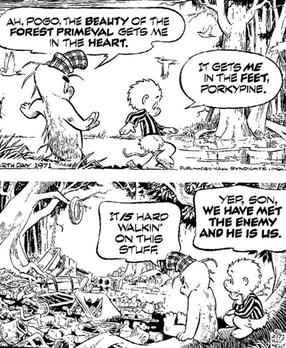
For those of you too young to know about Pogo, you were born too late. It was Pogo who first said, "We have met the enemy and he is us."
And, he gave us the world's most beloved Christmas Carol.
Deck us all with Boston Charlie,
Walla Walla, Wash., an' Kalamazoo!
Nora's freezin' on the trolley,
Swaller dollar cauliflower alley-garoo!
Don't we know archaic barrel,
Lullaby Lilla boy, Louisville Lou?
Trolley Molly don't love Harold,
Boola boola Pensacoola hullabaloo!
Bark us all bow-wows of folly,
Polly wolly cracker n' too-da-loo!
Hunky Dory's pop is lolly gaggin' on the wagon,
Willy, folly go through!
Donkey Bonny brays a carol,
Antelope Cantaloup, 'lope with you!
Chollie's collie barks at Barrow,
Harum scarum five alarum bung-a-loo!
Merry Crispness!
It makes me sick
Although,as I said yesterday, the social environment is a very powerful determinant of health, in the U.S. we tend to think more about the physical environment. I suspect that's because it doesn't force us to ask questions that are quite as difficult. Nevertheless, the physical environment is important. Since we’ve cleaned up some of the worst offenses of the industrial revolution, it’s not as big an issue in the U.S. as it once was, but in much of the world, malnutrition and contaminated water slaughter children by the millions every year. Here, motor vehicle crashes and other unintentional injuries still take a dreadful toll, and you’d be surprised how much death and disease results from exposure to motor vehicle exhaust. (Check out the CAFEH study for some interesting info.)
Obviously, the physical environment is shaped strongly by the social environment and it's often hard to tell them apart. Are people in hazardous occupations, or harmful food environments where junk food is cheap and fresh produce unavailable, facing risks from the social or physical environment?
Now let's turn to personal characteristics and behaviors. Of course, we have our genetic endowment, which predisposes us to particular health problems as it interacts with our environment. Worst of all, each and every one of us is born with a progressive, incurable, ultimately fatal disease which will eventually cause us to lose lean muscle mass, lose skin tone, suffer declining immunological function, declining cognitive function, slower healing and recovery from injuries, and yes, we’re all going to die.
So what about those areas of personal responsibility? Libertarians will tell you that a lot of what drives our health status is individual choice. We should be left alone to make those choices, and to suffer or enjoy the consequences. I’m not going to get into the question here of whether free will is an illusion, but we are obviously not entirely autonomous. To a considerable extent, we do what is considered normal or respectable in our social milieu. We also don’t necessarily know exactly what’s good for us. And corporations, in order to extract money from us, will often deceive us about that. Tobacco companies spent literally billions over decades to persuade us that smoking wasn’t really dangerous, and kids today are subjected to thousands of commercials every year for junk food.
And, people get addicted. It’s common to blame addicts for their situation but that is a false view of human behavior. Our behaviors are driven by specific pathways in the brain that get hijacked by addiction. It’s very difficult to overcome. And finally, do we really want to make people bear the burden all their lives of choices they made when they were young and foolish, as we all have been?
So is tobacco a feature of the social environment, the physical environment, or personal behavior? It's all three, of course.  Ultimately, our good or bad health is largely a matter of chance: where we happened to be born, into what circumstances, with what genes, into what society, every random thing that happens to us. It doesn't matter who you are or what kind of personal responsibility you believe in, something bad might just happen to you.
So that’s where insurance comes in. Libertarians will say, “Why should everybody have health insurance? We don’t have a third party to buy our groceries.” Truly, I’ve heard that said. Well, it’s because of the immense disparities in people’s need for health care. It could be a little, it could be a lot, it could be catastrophic. Furthermore, there is a gradient over the life course. Without insurance, most people who really needed a lot of health care couldn’t possibly afford it. And, as I said at the beginning, if we depend on people to buy it out of their pocket it will be underproduced – there will be all those negative effects for the whole society of people not getting care they need. Note that underproduction in this case refers not to the sheer quantity, which in our country is too much, not too little; but rather to the right stuff at the right time. This is a very important distinction.
So next time: How insurance markets work. And no, it is absolutely nothing like Joe Lieberman wants you to believe.
Tuesday, December 22, 2009
A highly efficient post . . .
. . . in two parts. First, let me clean up one more small point about the bogosity of economics as taught to freshmen and believed by pundits and politicians everywhere. This is the assertion that the "free market" allocates resources "efficiently." This statement is not even wrong. It is meaningless, even assuming (as economists are wont to do) that the "free market" actually exists or could exist.
The concept of efficiency only makes sense if you first specify what it is you are trying to achieve. If I stipulate that I want to build a 1,400 foot house with a full basement, two bathrooms, two bedrooms, with 2x6 framing, an 800 square foot sunroom, two woodstoves, passive solar design, etc., it then makes sense to talk about how to get it done in the least amount of time or for the least amount of money, or both assuming the goals are not incompatible.
If I want to claim that a market is efficient, I first have to simulate what results I want from it. If you believe that the market should deliver you a Mercedes Benz, or feed all the hungry kids in Africa, and those things aren't happening, then the market is not efficient, no matter what anybody else tries to tell you. End of discussion. There is absolutely no argument from the theory of the idealized market to any conclusion that its results must be proper, good, just, appropriate, moral, Christian, natural, or any other assertion about values. If you don't like the result, then you don't have to, and any claim about "efficiency" is utter balderdash.
Whoo. Now that I've cleared the air about that, let us move on to the determinants of health. (Don't worry, this is all part of one logical, coherent argument. Give me time.) Although these categories are somewhat arbitrary and in fact they are mutually interpenetrating, as we say, it is conventional to think about the determinants of health in three parts:
- the social and economic environment,
- the physical environment, and
- the person’s individual characteristics and behaviors.
To keep this post to a conventionally blogistic length, I will deal only with the social environment today. Important components include people's income and social status -- which of course can vary by gender, ethnicity and caste as well as occupation and position in formal hierarchies; level of formal education; social supports from family, friends and community; the person's culture with its accompanying customs and traditions; exposure to interpersonal violence; and all that sort of thing.
One of the most interesting observations social scientists have made, and this is now pretty well established, is that the level of inequality in a society is an independent predictor of population health, regardless of the absolute level of wealth. In other words, a person with an income of 500 bars of gold-plated latinum per year will tend to be healthier and live longer, all other things being equal, in a society with low inequality, in which most people have an income not very different, than in a society in which most people get only 200 bars of latinum per year and a small number get 10 million. The latter society, by the way, is kind of like ours, which is one reason why we are less healthy than the Europeans and Canadians.
I will get on with the rest of it tomorrow. Meanwhile, stay efficient.
Monday, December 21, 2009
The World Turned Upside Down
Actually, the world is still right side up. It's the junk economics that permeates our political culture that is upside down.
The obvious question raised by yesterday's post is why those people in the lower spending regions aren't getting such great benefits from Medicare as the people in the higher spending regions. Obvious, but completely wrong. It turns out the people in the lower spending regions get better health care than the people in the high spending regions. According to Fisher, Goodman, Skinner and Bronner, with the Dartmouth Atlas of Health Care, in higher spending regions:
Technical quality
-- Adherence to evidence-based care guidelines worse.
Health outcomes
-- Mortality higher following acute myocardial infarction, hip fracture, and colorectal cancer diagnosis.
Physician perceptions of quality
-- More likely to report poor communication among physicians and inadequate continuity with patients.
-- Greater difficulty obtaining inpatient admissions or high-quality specialist referrals.
Patient experience
-- Worse access to care and greater waiting times. (“paradox of plenty”
-- No difference in patient-reported satisfaction with ambulatory care.
-- Worse inpatient experiences.
* High- and low-spending regions were defined as the U.S. hospital referral regions in the highest and lowest quintiles of per capita Medicare spending as in Fisher (2003).
Why do you have to wait longer where supply is more plentiful? Because utilization is even higher. Isn’t this the exact opposite of what your Economics 101 professor told you?
Why yes it is. Reality is not cooperating with that theory of the Free Market. And one of the key reasons is that it is suppliers, not consumers, who control demand in health care. Now, of course most physicians perceive themselves as acting in the best interest of their patients. However, they get paid for doing stuff. What is more, specialists get paid a whole lot more for irradiating you and slicing and dicing you than primary care docs do for listening to you and giving healthy advice. Therefore, we have more specialists than other countries and fewer primary care doctors, and we spend more on the zapping and cutting as a result. Doctors aren’t necessarily conscious of this but it’s just human nature. Surgeons think you need surgery, radiologists think what you really need is radiation, oncologists think you need chemotherapy. It’s unlikely that they’ll think you shouldn’t do anything, but often that’s the best course.
Now, conservatives and some physicians talk a lot about how fear of malpractice suits drives overutilization. I won't get into that in any depth right now because it would be a bit of a digression, but the problem has been greatly exaggerated. Total malpractice payouts per capita in 2001 were $16 in the U.S., $12 in the UK, and $10 in Australia. Not a huge difference, and maybe we just have more malpractice? Adding the cost of defending malpractice suits and insurance underwriting expenses, malpractice payments are less than 5% of health care spending in the U.S.
The conventional wisdom is that malpractice premiums have steadily risen and now constitute a crisis for medical practice. American Medical Association (AMA) surveys of self-employed physicians from 1970 to 2000 indicate that premiums were lower in 2000 than in 1986. There is a commonly accepted range of estimates, that from 44,000 to 98,000 Americans die every year from avoidable errors made in hospitals. The number who are injured, including many serious injuries, is obviously much higher. The vast majority of these incidents do not result in any malpractice claims at all. We have a problem in that the only method we have available for compensating people who are injured by medical errors is malpractice litigation. That's bad for both patients and doctors, and it should be fixed, but it is absolutely not an important reason for our high and out of control health care spending.
But I digress. The last quite substantial influence on utilization is the local peer culture, basically. It’s just the way we do things here in Walla Walla Wash or Kalamazoo. In order to appreciate how this can be, you need to know that most of what physicians do is actually not based on clear evidence; it’s based on conventional wisdom, personal habits and proclivities, accepted practice. People are surprised to learn that we’ve actually needed a movement toward evidence based medicine in recent years, because it has not been the standard all along.
Next time: Efficiency, and the causes of health.
Sunday, December 20, 2009
Consumer Sovereignty
I haven't posted much on Stayin' Alive on weekends lately, but due to enforced hibernation you get a bonus post today. As I said last time, we don't buy medical services -- or have our insurance pay for them -- because we enjoy having our livers resected, we generally do it because we feel compelled. 
Source: Jason M. Sutherland, Ph.D., Elliott S. Fisher, M.D., M.P.H., and Jonathan S. Skinner, Ph.D. NEJM.org, Sept. 9 2009
So here are figures on Medicare spending, depending on people’s self-reported health status. Obviously, as you might expect, people who are in poor health use more services. Just as obviously, they don’t do so out of choice. They are not exercising their liberty, on the contrary, their liberty is constrained by their condition. (Figures on privately insured people would show a similar relationship, but they are not as readily available. Of course pregnancy and childbirth, as well as sickness, drive part of the cost for younger women, but that doesn't contradict the principle.) (You'll also note that Medicare spending is concentrated among people in the last year of life, but that doesn't mean it's all wasted. If we could perfectly predict who is about to die, we might be able to save some money on futile measures, but we generally can't predict very well. More on all that later.)
So yes, sick people cost more, but that's not the whole story. 
This is another graph from the same article by Sutherland and colleagues. Here we see that Medicare spending varies enormously by region of the country. However, it is not the case that people in the higher spending regions tend to be sicker; or at least that's a very small part of the reason. Here's how they explain it:
[I]n regions where there are more hospital beds per capita, patients will be more likely to be admitted to the hospital—and Medicare will spend more on hospital care. In regions where there are more intensive care unit beds, more patients will be cared for in the ICU—and Medicare will spend more on ICU care.
And the more CT scanners are available, the more CT scans patients will receive. . . [I]n regions where there are relatively fewer medical resources, patients get less care—and Medicare spends less. So geography becomes destiny for Medicare patients.
So evidently, it is not consumer choice that is driving the demand for medical services. It's something else, something they never told you about in Economics 101. Something is very fishy about that relationship between price, supply and demand that the guy in the bow tie lectured about. In fact, it's even fishier than you may already be thinking. More on this anon.
Friday, December 18, 2009
Real World Economics
Listen up, ye Sons of Liberty!
Markets are not natural phenomena, or forces of nature. Markets are social constructions -- institutions created by humans, maintained by humans, shaped and controlled by humans.
All markets are regulated.
In complex societies, all markets depend on sustained, intrusive government intervention in order to function.
The only question is what form that intervention takes, and who benefits.
Markets are not separate from politics: their nature is controlled by the political institutions on which they depend for their existence.
The idealized market, even if it could exist, which it cannot, has no relationship to justice.
It is true of all markets that they do not resemble the fictitious entity presented in Economics 101, but this happens to be particularly easy to see in the case of health care. Let's start with that notion of externalities. Again, these are not the exception or a minor issue in the market for any good or service, but I don't want to get side tracked.
When a person receives health care, assuming it is effective, obviously that person benefits, and might be willing to pay something for it, assuming she or he had the money. But a whole lot of other benefits happen to other people as well. Here is just a partial accounting.
An obvious one is communicable disease control. If you cure or prevent an infection in one person, you can end up protecting a whole lot of people who have nothing to do with the medical encounter. Furthermore, the patient may be in the workforce, and his or her good health may contribute to the prosperity of all. Paid employment aside, people care for children and sick or disabled relatives, keep house, do volunteer work, help out friends – all sorts of good works that aren’t part of the money economy.
And, other people – family and friends -- might just care what happens to a sick person, and feel distress if they don’t get proper care, or can no longer be friends and companions. Furthermore some of us may feel bad about the sufferings of the unfortunate in general, and feel good about being part of a society that provides basic, compassionate care for everybody. And the last item I’m going to list is that it just isn’t very pleasant to have to step over sick and dying people all the time or pass mentally ill and disabled beggars on every corner. Actually if you live in the city you’ll find that you actually do a fair amount of that, right here in the Greatest Country on Earth.
So health care is in fact a mixed good (as are most goods, after all). If we had to depend on people to buy only as much of it as they could afford, or felt inclined to buy, it would be underproduced from a societal point of view – all of us would be losers.
Okay, let’s deal with a couple more assumptions. Obviously, as patients, we don’t have perfect information. That’s why we go to the doctor in the first place. The doctor has expertise we don’t have. Most of us have no way of knowing whether the doctor’s diagnosis and prescription are correct, because we don’t have a medical degree. Some of us are in a position to be better informed than others, but unfortunately, some of us also think we know more than we really do.
And obviously there is not and cannot be perfect competition among health care providers. In medically underserved areas, there is often none at all. Marcus Welby didn’t have any competition, he was the only doctor in his small town, and everybody figured that was beautiful. At the other extreme, many high tech services are available in very few places, and people outside of the major cities may have to travel hundreds of miles to get to them. That includes trauma care, by the way, which can come upon you in an instant, out of the blue. When you’re unconscious and bleeding to death from a car crash, you don’t have a discussion with the ambulance driver about which hospital you want to go to, let alone whether you want to go at all.
And, since medicine is all about expertise, and we can’t evaluate physicians’ expertise, it has to be done for us, by licensing and credentialing bodies. That means the supply of physicians is restricted – you can’t just have random people setting up physicians’ offices. Of course, many people do by claiming to be homeopaths or naturopaths or what not, but they’re probably just stealing.
So what about consumer sovereignty? Everybody has fairly similar basic needs for food, clothing, and shelter, which we satisfy if we can; and then we go on to allocate our remaining income according to our desires. But the need for health care differs radically among individuals, and it’s not something we generally get more of than we need because we want it. For sane people, getting medical interventions is generally unpleasant and to be avoided; we undergo them out of necessity.
Alright, that's a lot of verbiage for one day. Next time, I'll once again have pictures, and we'll talk about how the production and consumption of medical services are really allocated.
Thursday, December 17, 2009
Ptolemaic economics

You are here. Whoops, no you aren't. We used to think so, but the earth is not at the center of the universe after all. Until Copernicus came along and published De revolutionibus orbium coelestium in 1543, astronomers had to reconcile their observations with a set of assumptions that happened to be false. As you can see, they had to add epicycles to the major rotations of the celestial spheres, put the center of rotation somewhere out in space rather than at the center of the earth, and in fact add more and more extra cycles and wobbles and froufrou that aren't even shown in the diagram. In addition to being bad at explaining and predicting, the Ptolemaic system was philosophically misleading. Once we understood that we aren't actually so special after all, our understanding of the very nature of existence began to change, and we experienced The Enlightenment.
Now let me make a personal statement because I tend to get some ad hominem responses about my personal qualifications whenever I say what I'm about to say. I have taken graduate economics courses at three different highly respected universities, and I had to pass qualifying examinations in economics for my Ph.D., which happens to be from Brandeis. So I know damn well how economics is taught and what is inside economics textbooks. This happens to be the same story that is generally accepted by reporters, pundits and politicians, and is bedrock in our political culture. Furthermore, classical conservatism, libertarianism, and neo-liberalism aren't just value systems: they are entirely unsustainable as coherent ideologies without faith in this self-same economic theory with which college freshmen are indoctrinated.
I say faith because economics is really more like theology than it is like science. The professor begins by enunciating a set of assumptions -- postulates, no different from assertions like "The Bible is literally true" or "God is omnipotent," for which no evidence is presented. From these assumptions, an elaborate theory is built which purports to describe reality. When, later on, it is impossible to avoid observing that the theory does not describe reality in one or another specific case, they call that a "market failure," which is supposed to be exceptional, and construct an epicycle.
This is not the procedure of science, which begins by observing reality and then searching for explanations of what is real. Scientific theories are built from data, not snatched out of the air. Scientists come up with new theories to explain new evidence -- e.g., the earth and planets go around the sun -- rather than trying to wrestle reality into conformity with their postulates, like theologians and economists.
Here are some of the assumptions underlying standard economic theory:
- All costs and benefits to society are captured in transactions between buyers and sellers
- Perfect information -- buyers know everything about the product and alternatives
- Perfect competition
- Consumer sovereignty – consumer choice drives demand
And a grand conclusion: “Free markets” are self-regulating and efficient.
There are more, all equally fallacious. It is not that there are exceptions to these postulates, or that they are a little bit wrong around the edges. They are always false, they have no relationship to reality. Any theory based on these assumptions is false, and the conclusion is not only false, but meaningless. One more thing: the false theory derived from these false assumptions does not, in fact, have anything to tell us about whether the outcomes from this fictitious free market are fair and just, but many economists and most politicians and pundits go from the supposed "is" -- that this fictitious "free market" is somehow the natural state of affairs or the way the world has been given to us by the creator -- to an "ought" -- that whatever outcomes it produces must be the right ones. This unmitigated nonsense lies at the very heart of our political discourse.
Next time, I will smash it all to rubble. As anyone can do.
Wednesday, December 16, 2009
Health care policy 101 -- cont.
Now I hope that I've demonstrated the simple proposition that we are paying twice as much for medical services as comparable societies, and getting worse health outcomes. To our shame, we aren't bearing the burden of our collective failure equally: disparities in health and life expectancy between rich and poor, black and white, are large and persistent. Here's the simplest possible presentation:
What this shows is that, while women on average live longer than men (a biologically determined fact, once you have reasonably safe child birth), in the U.S., white people live longer than black people. (In case the graph is a bit confusing, white men have about the same life expectancy as black women; white women have the highest and black men the lowest.) As you can see, while life expectancy has generally been increasing, the disparities have remained essentially unaffected.
Former Surgeon General David Satcher and co-authors noted in Health Affairs in 2005 that 83,570 Black Americans die prematurely every year who would not die if that mortality gap were eliminated. That is the equivalent of loading a jumbo jet every day and crashing it into the ground with no survivors – week after week, year after year, forever. This is an excruciating national embarrassment. The corporate media -- not to mention Daily Kos -- are full of stories about influenza and rare events such as deaths from food poisoning or unusual medical conditions, but this is going on all the time and it’s largely ignored. I’ll let you speculate about why that is.
But now we come to the problem that has actually gotten the attention of powerful people.
Health Care Spending as Pct. of GDP, U.S.
This is health care spending in the United States as a percentage of GDP. And yes, it has also tended to increase in other countries: new medical technologies come along all the time, and they are usually expensive. People place a high value on cure, if possible, and failing that palliation. We want to live and function well and if there is hope of that we'll pay for it. The problem is that health care has gotten so expensive in the U.S. that under our present system of financing, a lot of people just can't afford it; and politicians and policy wonks are starting to worry about the affordability of Medicare to the federal government and of Medicaid to both federal and state government. Long term, this relentless cost growth is driving more and more people out of the system and threatening public solvency.
Next up: Economics 101
Tuesday, December 15, 2009
We're Number One!
Not! You'll hear a lot of people say that the United States has the best health care system in the world. There must be other reasons why we don't match up well on life expectancy and other indicators of population health. Some will go so far as to say that universal coverage does have something to do with it, and maybe we should try to achieve that, but not at the cost of "rationing" or putting government bureaucrats in charge who will ruin the magnificent edifice created by our private system.
I really don't think so. Here you can see that according to an international survey done just last year, we appear to have the worst health care of all the wealthy countries (there were more countries in the survey but I’ve just showed you a sample). People with chronic illnesses in the U.S. often can’t afford their medications, don’t get appropriate treatments, are least likely to have a regular doctor, and have their time wasted by our disorganized, fragmented system. 
Not only that, but we spend more out of pocket. 41% of U.S. respondents had out-of-pocket costs of more than $1,000. Lowest was UK with 4%; Canada was second-highest with 20%. Okay, well even if the patient's experience isn't great, we're still delivering the best technical quality medicine, right? Err. . .
We get bad results from our health care system. These investigators just looked at certain causes of death which can be prevented or delayed by health care, and looked at age-adjusted death rates from these causes alone. As usual, we’re number last.
So what exactly is it that the Republicans in the Senate and Joe Lieberman are determined to preserve? I have even more bad news on that tomorrow.